Welcome to our buyer's guide for CNC routers! Whether you're a seasoned professional or a hobbyist exploring the exciting world of computer numerical control (CNC) machining, this guide is designed to help you navigate the complex landscape of CNC routers. With the rise of digital fabrication, CNC routers have become indispensable tools across various industries, from woodworking and metalworking to manufacturing and prototyping.
In this guide, we will walk you through the essential factors to consider when purchasing a CNC router, ensuring you make an informed decision that aligns with your specific needs and budget. We will cover key aspects such as machine types, sizes, features, software compatibility, and maintenance requirements. Additionally, we'll provide insights into the latest technological advancements and industry trends, helping you stay ahead of the curve.
By the end of this guide, you will have a clear understanding of what to look for in a CNC router and how to choose the perfect machine for your projects. Let's dive into the world of precision, efficiency, and innovation with CNC routers!
CNC routers have revolutionized numerous industries by offering unparalleled precision, efficiency, and versatility in material cutting and shaping. These computer-controlled machines have become integral tools across various sectors, transforming production processes and enabling innovative designs. Here’s a closer look at the importance of CNC routers in different industries:
Woodworking has been profoundly impacted by CNC routers. These machines allow for the creation of intricate designs and detailed carvings that would be challenging or impossible to achieve manually. CNC routers are used to produce furniture, cabinetry, decorative pieces, and even intricate architectural elements. Their ability to cut complex patterns with high precision reduces waste and improves overall productivity.
In the metalworking industry, CNC routers are essential for cutting, drilling, and engraving various metals, including aluminum, brass, and steel. They are used to manufacture parts for automotive, aerospace, and machinery applications. The high precision of CNC routers ensures that components meet exact specifications, which is critical for the safety and functionality of metal products.
CNC routers have become indispensable in the sign-making industry, enabling the production of detailed and durable signs from materials like wood, plastic, and metal. They allow sign makers to create custom designs, 3D lettering, and intricate graphics with ease. This versatility helps businesses and organizations to effectively brand and market themselves.
For prototyping and small-scale manufacturing, CNC routers offer rapid and accurate production of prototypes and parts. They are widely used in the electronics, consumer goods, and medical device industries to create prototypes for testing and development. This capability speeds up the product development cycle and allows for iterative design improvements.
The plastics and composites industry benefits from CNC routers' ability to cut and shape materials like acrylic, polycarbonate, and fiberglass. These materials are commonly used in the automotive, aerospace, and construction industries. CNC routers provide the precision needed to create components with tight tolerances, ensuring a perfect fit and finish.
Educational institutions utilize CNC routers for teaching students about manufacturing, engineering, and design principles. These machines offer hands-on experience with modern fabrication technology, preparing students for careers in various technical fields. CNC routers in educational settings foster creativity and innovation among students.
Artists and designers leverage CNC routers to bring their creative visions to life. The ability to cut complex shapes and patterns from a variety of materials expands the possibilities for artistic expression. CNC routers are used in sculpture, jewelry design, and custom décor, allowing for unique and personalized creations.
In the automotive and aerospace industries, CNC routers are crucial for producing lightweight and high-strength components. They are used to fabricate parts from advanced materials like carbon fiber and aluminum composites. The precision and consistency of CNC routing are vital for ensuring the safety and performance of vehicles and aircraft.
The construction industry utilizes CNC routers to create components for buildings and infrastructure projects. They are used to cut and shape materials like wood, metal, and insulation panels for precise installation. CNC routers improve construction efficiency, reduce material waste, and enable the production of custom architectural elements.
CNC routers have emerged as game-changers in the world of craft making, offering artisans and hobbyists a powerful tool to bring their creative ideas to life with precision and efficiency. These machines, which use computer numerical control (CNC) technology to automate the cutting, carving, and engraving processes, have opened up new possibilities for craft enthusiasts across a range of disciplines. Here’s how CNC routers are transforming craft making.
CNC routers have become indispensable tools in the furniture-making industry, revolutionizing the way artisans and manufacturers approach design and production. These machines bring a level of precision and efficiency that is difficult to achieve with traditional woodworking techniques. With a CNC router, furniture makers can create intricate patterns, detailed carvings, and complex joinery with exceptional accuracy. This precision not only ensures that each piece fits together perfectly but also allows for the production of high-quality furniture that meets exact specifications and maintains consistency across multiple pieces.
CNC routers have significantly enhanced cabinet making by providing precision, efficiency, and versatility to the process. These machines enable cabinet makers to produce highly detailed and complex designs with consistent accuracy, ensuring that each component fits together perfectly. Whether cutting intricate door panels, creating precise joinery, or carving decorative elements, CNC routers streamline the production process, reducing the time and labor required. The ability to work with various materials, including wood, MDF, and plywood, allows for a wide range of cabinet styles and finishes. Additionally, the use of digital design files facilitates easy customization and replication, making it possible to offer personalized cabinetry solutions to clients without compromising on quality or increasing production costs. This technological advancement not only enhances the quality and consistency of the finished product but also allows cabinet makers to explore innovative designs and cater to diverse customer preferences efficiently.
A CNC (Computer Numerical Control) router is a computer-controlled cutting machine used for a variety of materials such as wood, composites, aluminum, steel, plastics, glass, and foams. CNC routers are a type of CNC machine, where the movements of the router bit are precisely controlled by a computer. These machines can be used to perform tasks such as cutting, engraving, milling, and drilling with high precision and consistency.

At the core of CNC routers is the principle of computer control. The machine operates based on pre-programmed instructions from a computer. These instructions are typically created using CAD (Computer-Aided Design) software, which translates a digital design into a language (G-code) that the CNC router can understand. This process ensures that the router can replicate complex designs with exact precision.
CNC routers typically operate along three primary axes: X (horizontal), Y (vertical), and Z (depth). Some advanced CNC routers may include additional rotational axes (A and B) for more complex three-dimensional work. The movement along these axes is controlled by motors, allowing the router to cut or carve intricate designs and patterns into the material.
The cutting tool, often referred to as the router bit, is a critical component of the CNC router. Different types of bits are used depending on the material and the desired outcome. The computer precisely controls the movement and speed of the router bit to achieve the desired cut. Different materials and applications often require different bits or tooling.
The precision of CNC routers is largely due to the use of drive motors that drive the movement along the axes. Motors move the cutting tool in fixed increments, providing high precision, speed and accuracy while minimizing any deviations from the intended path.
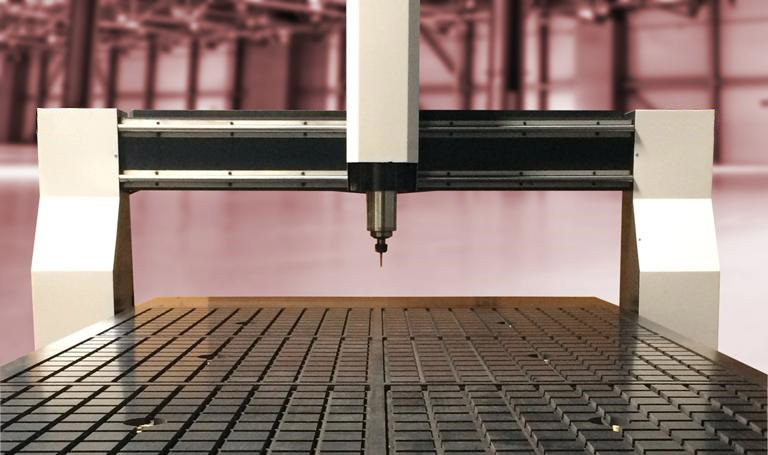
The spindle is the motor that holds and spins the router bit. It determines the cutting speed and is a crucial factor in the machine’s ability to handle various materials. Higher-powered spindles can cut through tougher materials more efficiently and with greater precision. High Frequency, Variable Speed, Liquid Cooled spindles are the preferred spindle of choice of production garde systems, with the majority of hobby or light class systems using fan or air cooled routers.
The workpiece is placed on the machine bed or table. Standard tables are equipped with a clamping system to secure the material in place during the cutting process. While Vacuum Bed system used suction to secure the material to the bed for cutting. Each option has advantages unique to the application being produced.
CNC routers rely on software integration for their operation. CAD software is used to design the part, and CAM (Computer-Aided Manufacturing) software translates the design into G-code instructions for the machine. Modern CNC routers often come with user-friendly interfaces and software that make it easier to design, program, and operate the machine, even for beginners.
In summary, CNC routers are sophisticated machines that utilize computer control to perform precise cutting and shaping tasks. Their ability to automate complex processes, work with a variety of materials, and produce consistent results makes them invaluable tools in many industries, from woodworking and metalworking to crafting and prototyping.
CNC routers operate on a fundamental principle of automating cutting, shaping, and engraving tasks through computer control. Here's a step-by-step breakdown of how CNC routers work:
The process begins with creating a design using CAD (Computer-Aided Design) software. This software allows users to create precise digital models of the parts or designs they wish to produce. The CAD software is versatile and can handle anything from simple shapes to complex geometries.
Once the design is complete, it is transferred to CAM (Computer-Aided Manufacturing) software. The CAM software converts the digital design into a series of instructions called G-code. G-code is a language that CNC machines understand, detailing the toolpath, speed, depth, and other parameters necessary for the router to execute the design.
The material to be cut or shaped is securely mounted onto the machine bed or table. Clamps, vacuum tables, or other holding devices ensure that the material stays in place throughout the machining process.
The appropriate router bit or cutting tool is selected and installed into the spindle of the CNC router. The choice of tool depends on the material being worked on and the type of operation (cutting, engraving, drilling, etc.).
The machine is calibrated to ensure precision. This involves setting the origin point (usually referred to as the home position) and verifying that the machine coordinates match the design coordinates.
The G-code instructions are loaded into the CNC router’s control software. The operator starts the machine, and the CNC router begins to execute the programmed instructions.
Drive motors drive the movement of the router along the X, Y, and Z axes. The motors follow the G-code commands to move the tool precisely to the specified locations, adjusting the depth, speed, and direction as required.
The router bit rotates at high speed, cutting into the material according to the programmed toolpath. The machine follows the intricate patterns and designs specified in the G-code, removing material layer by layer or in a continuous cut.
The spindle speed (how fast the tool rotates) and the feed rate (how fast the tool moves through the material) are critical parameters controlled by the machine to ensure optimal cutting conditions and material removal rates.
The operator monitors the machine’s progress to ensure everything runs smoothly. Modern CNC routers often come with features that allow for real-time monitoring and adjustments if necessary, ensuring high precision and avoiding errors.
Once the G-code instructions are fully executed, the machine stops, and the finished part is ready to be removed from the bed. The workpiece is carefully detached, and any holding devices are removed.
Depending on the project, additional finishing processes such as sanding, polishing, or painting might be necessary to achieve the desired final product quality.
After completing the job, the router bit and machine components are cleaned and inspected for wear. Proper maintenance ensures the longevity and accuracy of the CNC router.
The workspace is cleaned, and any leftover material or debris is cleared away to prepare for the next project.
In essence, CNC routers transform digital designs into physical objects through a combination of precise computer control and mechanical movement. This automation allows for high precision, repeatability, and efficiency, making CNC routers invaluable tools in various industries, from manufacturing and prototyping to crafting and custom design.
Click here to learn the best CNC router for your application and budget.
Decades of Innovation, A Lifetime of Support.
Industrial CNC is the global leading manufacturer of Industrial Strength, Integrated CNC Router and Plasma Systems.
From design to engineering and manufacturing, Industrial CNC has one goal: Providing our customers with the strongest, fastest and most affordable CNC Router Systems available backed by an unwavering commitment to customer service and Free Lifetime Technical Support.